
Reviewed · UNESCO HERITAGE TOURS
Gyeongju UNESCO Sites Tour by KTX train; The Museum Without walls
Gyeongju’s Silla sites feel like time travel. This KTX-powered private day trip strings together burial mounds, a palace-pond complex, and UNESCO temples with an English-speaking guide, plus admission fees handled for you. My favorite part is how smoothly the schedule flows for a long day, and the other big win is the way the guide connects the dots across stops. The main drawback is simple: it’s still an 8 to 9 hour day, and several highlights are outdoors, so rain or strong sun can change the experience.
You start early from Seoul (7:00 am) and you’ll ride in a private vehicle for transfers, then take the train both ways. You get a calm, “less stressful than DIY” pace, but you won’t have a hotel drop-off back in Seoul, so plan your end-of-day ride ahead.
In This Review
- Key things I’d bet you’ll notice on this tour
- Why Gyeongju works best as a day trip (and why the train is the key)
- Getting picked up, finding your train seat, and staying calm
- Cheonmachong Tomb, start with the burial mounds
- Gyeongju National Museum: the one stop that makes everything else click
- Cheomseongdae Observatory: the star-gazing tower built in 634
- Donggung Palace and Wolji Pond (Anapji): the court, the water, and the drama
- Bulguksa Temple: when Silla Buddhism becomes stone and scale
- Seokguram: the hermitage 750 meters up with sea views
- How the 8 to 9 hour rhythm works for real people
- Price and value: is $470 worth it for this much moving?
- The human factor: guides who handle the details
- Who should book, and who should choose another plan
- Should you book this Gyeongju UNESCO Sites Tour by KTX?
- FAQ
- What time does the tour start?
- How long is the tour?
- Is pickup from my hotel included?
- Are admissions included in the price?
- Does the price include KTX train tickets?
- Will the tour drop me back at my hotel in Seoul?
- Is cancellation free?
Key things I’d bet you’ll notice on this tour
- KTX round trip included so you skip the train math and just show up.
- Private car transfers in Korea, not a patchwork of taxis.
- A Silla-focused route that hits tombs, observatory tech, court ponds, and top Buddhist sites.
- Cheonmachong Tomb and an outdoor museum vibe (yes, it is an open-air kind of history).
- Bulguksa plus Seokguram in one go, including the big viewpoint at Seokguram.
- A museum stop that gives your feet a break before you climb again.
Why Gyeongju works best as a day trip (and why the train is the key)
Gyeongju is the kind of place where the city is the museum. You’re not just looking at one famous artifact, you’re walking through layers of Silla-era life, from royal burial mounds to court architecture to Buddhist art. That’s why people call it a Museum Without Walls.
The biggest challenge from Seoul is distance and timing. The high-speed rail helps because it turns “too far for a day trip” into “doable, with energy left over.” Also, because the tour is set up around the train schedule, you’re not guessing when to leave or how long each stop will take when crowds and transit get messy.
More UNESCO Heritage Tours in Seoul
- Day Trip to UNESCO: Suwon Fortress Adventure from Seoul
★ 5.0 · 56 reviews - Full-day UNESCO Heritage Tour with Suwon Hwaseong from Seoul
★ 5.0 · 28 reviews - Andong Hahoe Village [UNESCO site] Premium Private Tour from Seoul
★ 5.0 · 24 reviews
Getting picked up, finding your train seat, and staying calm
This tour is built around a straightforward rhythm: hotel pickup in Seoul areas, private vehicle transfer, KTX both ways, then more car transfers once you reach Gyeongju. You start at 7:00 am, and that early start is a real gift because Gyeongju sites can get busy, and outdoor stops look better when the light is on your side.
In the experience, the staff takes the “seat finding and station navigation” seriously. People in your group may get help getting to the subway and onto the right train, and you’ll likely have a guide waiting for you after arrival. That matters more than it sounds, especially if your Korean is basic and your brain is still waking up.
One practical note: you’re not promised hotel drop-off at the end. So your plan for getting back in Seoul should not be flexible. If you rely on a specific ride, set it up so you’re not scrambling at the finish.
Cheonmachong Tomb, start with the burial mounds
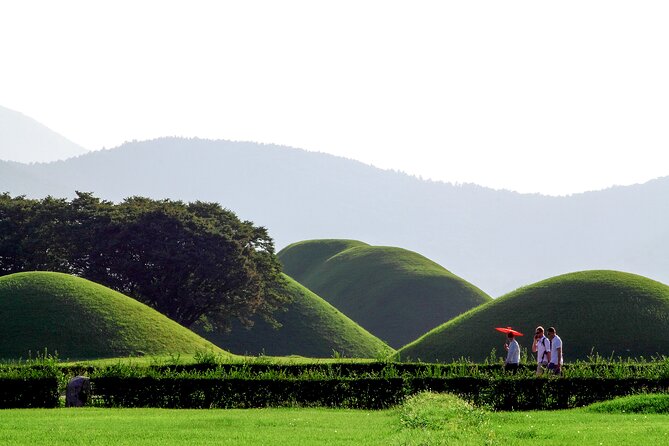
The day begins with Cheonmachong Tomb, a cluster of more than 20 Silla-period tombs. Most are earthen and mound-shaped, which is exactly the point. This is not marble statue tourism. It’s about understanding how royal power and court status were expressed in the landscape.
This stop is also a strong orientation moment. Burial mounds are one of the easiest ways to wrap your head around Silla hierarchy without needing a textbook. You get a feel for scale, placement, and the fact that these weren’t single tombs like a postcard. They were connected structures for families and officials.
The specific detail that sticks here is the presence of unusual shapes, including a double gourd-shaped tomb. It’s the kind of thing your guide can explain in a way that makes you look twice and remember the forms later.
Downside to know: this is a tomb and you’ll be outside. If it’s raining, muddy paths and slippery surfaces are not theoretical. Bring shoes you trust.
Gyeongju National Museum: the one stop that makes everything else click
Then you hit Gyeongju National Museum, a place people call one of Korea’s best history museums. Here’s the value: it gives you context for what you just saw in tomb form, and what you’re about to see in court and temple form.
This is also where the day gives you a breather. The main archaeological space is the kind of indoor stop that helps on long days, because you can reset your pace and regroup your thoughts. The museum admission on this tour is free, which is a nice bonus when you’re thinking about the all-in cost.
What to do when you’re there: don’t try to read everything. Pick the themes your guide is talking about, then use the museum to confirm what you’re hearing. That keeps you from turning the visit into a hurried blur.
Same trip, a different corner of the country:
- Best DMZ Tour Korea from Seoul (Red Suspension Bridge Optional)
★ 5.0 · 41,422 reviews - DMZ Tour: 3rd Tunnel, Option(Suspension Bridge, Boat) from Seoul
★ 5.0 · 21,373 reviews - DMZ tour south Korea from Seoul (NK experience hall, defector)
★ 5.0 · 20,599 reviews - Seoul: The Best DMZ Tour with Optional Suspension Bridge
★ 4.7 · 4,978 reviews
Cheomseongdae Observatory: the star-gazing tower built in 634
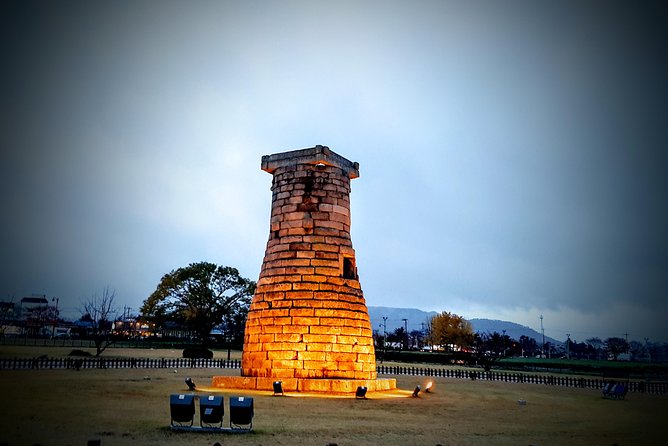
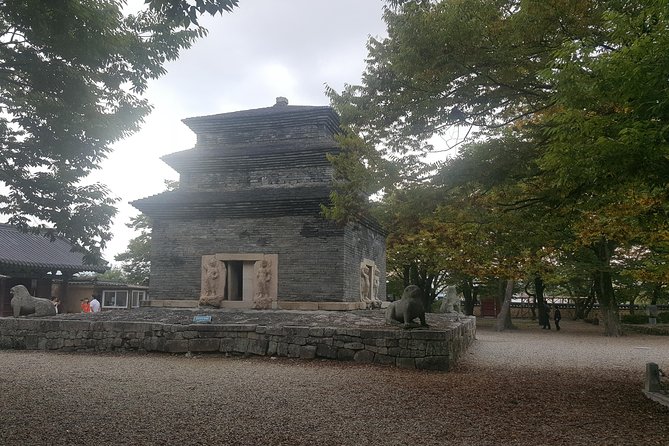
Cheomseongdae means star gazing tower, and it’s one of the standout “how did they do this” stops. It was built in 634 during the reign of Queen Seondeok, and it’s described as the oldest existing observatory in the Far East.
The structure is the lesson. You’ll see the 27 levels of stones, and you’ll learn how the tower fits into Silla ideas about astronomy and order. Even if you don’t care about astronomy, it’s a concrete example of how science and statecraft were linked in old Korea.
This stop also works as a pacing tool. It’s not the longest visit, but it gives you a mental break between bigger temple and courtyard moments.
Donggung Palace and Wolji Pond (Anapji): the court, the water, and the drama
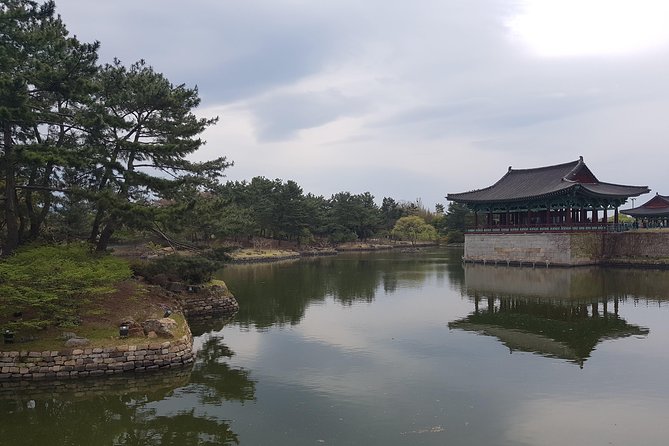
Donggung Palace and Wolji Pond is where the tour shifts from power and religion into daily court life. Wolji Pond is also known as Anapji Pond, and it was built in 674 after the unification of the Korean Peninsula. That date matters because it tells you the pond is not just decoration. It’s part of a larger political and cultural project.
In this stop, you’ll see how the palace and pond were designed together. Inside the palace walls there were constructed mountains, and the grounds included trees and flowers. The idea is that the court could enjoy a curated world inside the palace boundary.
Also, Wolji Pond is a “look and imagine” location. During your visit, you can picture guests walking the grounds, the pond reflecting buildings, and the space being used as a stage for ceremonies and status.
Downside to consider: again, you’re outdoors near water and open space. It’s worth dressing for weather, because wind and rain can make this stop feel colder or more gray.
Bulguksa Temple: when Silla Buddhism becomes stone and scale
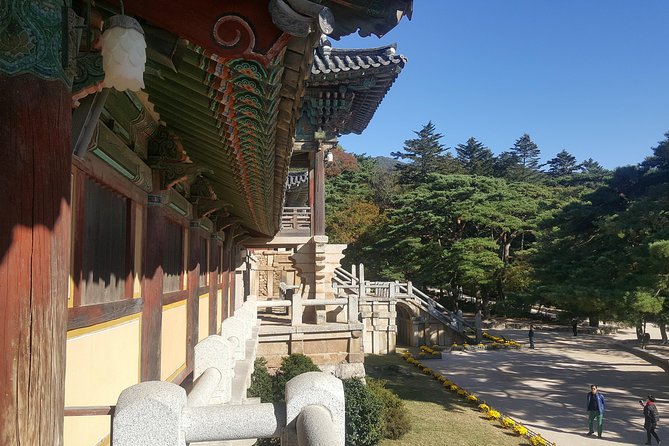
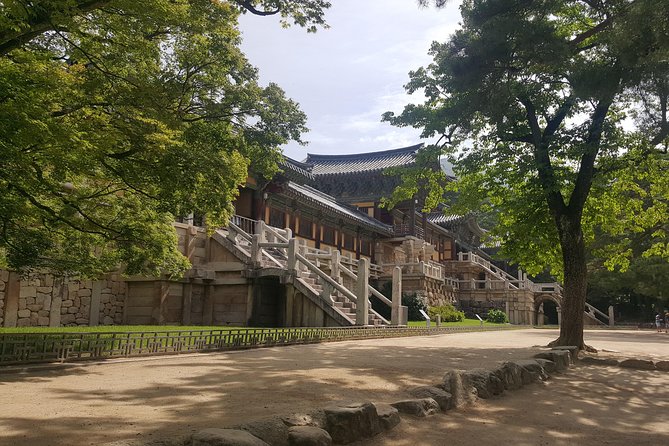
Bulguksa Temple is the most famous Buddhist temple in Korea, and it’s home to important Silla relics. The stop is included on the tour with admission, and it’s also a key reason the itinerary makes sense. Bulguksa sets the stage for Seokguram, since Seokguram is part of the same complex.
One detail that helps you appreciate Bulguksa quickly is that it includes well-known stone pagodas, including Dabotap. Even if you’ve never visited before, these kinds of landmarks act like visual anchors. Your guide can explain how they fit into the Buddhist world the Silla kingdom supported.
What I like about pairing Bulguksa and Seokguram is that you get two sides of the same heritage. Bulguksa is about temples and sacred structures at ground level. Then Seokguram is about the art and the setting, high above the sea.
Seokguram: the hermitage 750 meters up with sea views
Seokguram is a hermitage complex connected to Bulguksa, and it sits about 750 meters above sea level. It also overlooks the East Sea, so you’re not just looking at sculptures, you’re seeing them in a dramatic location.
This stop is where your day can feel truly special, because the combination of elevation plus Buddhist art creates a different mood than the tombs and ponds earlier in the day. You get a sense of why this place was built where it is, with quiet and distance built into the approach.
What to watch for: Seokguram involves walking and can mean uneven surfaces. Wear shoes with grip. If weather is bad, views can be less visible, but the sculptures and the setting still matter.
How the 8 to 9 hour rhythm works for real people
This tour runs about 8 to 9 hours. That’s a long day, but it’s also a very normal length for a Seoul to Gyeongju hit list that includes multiple major sites. The key is the order. You start with tombs, move into an indoor museum, go to a stone observatory, then hit the court pond area, and finally end with temples and Seokguram.
Meals are not included. That means you should plan a lunch strategy. One guide on this kind of tour is known for steering the group toward a local restaurant, and people mention lunch portions being large. Translation for you: don’t assume you’ll snack lightly and still feel good. Bring cash or a card that works, and consider a light breakfast since you’ll be busy all morning.
Energy tip: treat each stop as one main takeaway, not a full museum crawl. If you try to take in everything, you’ll feel rushed in the later temple portion, especially with outdoors involved.
Price and value: is $470 worth it for this much moving?
At $470 per person, this is not a bargain-basement day trip. But it’s also not just paying for sightseeing. The cost is tied to real logistics: round-trip KTX economic class, hotel pickup in Seoul areas, roundtrip transfers with a private vehicle, an English-speaking guide, and admission fees for the sites.
To judge value, look at what’s included that’s hard to DIY smoothly:
- Train tickets and timing managed for you
- A guide to connect each site to Silla context
- Admission handled, so you’re not stopping to find tickets mid-day
- Transfers with a private car, which is the difference between comfortable and chaotic
If you were doing this on your own, you’d likely spend time coordinating routes, figuring out which sites connect easily, and losing some of the “flow” that makes a day like this enjoyable. The tour is basically buying you time and simplicity, and that can be worth the premium.
That said, if you prefer total freedom and you hate fixed schedules, you might feel the cost is “too controlled.” In that case, build your own plan or choose a shorter route.
The human factor: guides who handle the details
This tour tends to get strong praise for how the guides work the day. People have mentioned guides such as Jay, Dylan, and John, plus the driver-like support from Andrew for handling the transition from Seoul to the train.
What makes that matter is how early travel can turn stressful. When someone helps you get to the station, keeps you on the right train, and meets you after arrival, the whole trip feels like a guided day instead of an organized puzzle.
If you’re the kind of traveler who likes history but also appreciates practical help, this fits. You’ll get explanations for what you’re seeing, plus support for the flow of the route.
Who should book, and who should choose another plan
I’d recommend this tour if you:
- Want multiple UNESCO and major Silla sites in one day
- Prefer English explanation over solo wandering
- Value stress-free transfers and handled admissions
- Like a structured itinerary even on a long day
I’d think twice if you:
- Want lots of downtime or slow pacing
- Don’t enjoy outdoor walking in variable weather
- Need hotel drop-off at the end of the day, since it is not included
If your main goal is one site only, you might get better value by picking a smaller set and going more slowly. But if you want a one-day hits-and-context approach, this is built for that.
Should you book this Gyeongju UNESCO Sites Tour by KTX?
Book it if you want a smooth, history-focused day that connects the Silla kingdom through tombs, astronomy, court culture, and major Buddhist heritage, all with KTX and admissions handled. The strongest reason to book is the overall “flow,” it turns a long-distance trip into something you can actually enjoy without constant logistics headaches.
Skip it if you’re ultra weather sensitive, dislike long days, or need the tour to end with hotel drop-off in Seoul. In those cases, you might feel boxed in by the schedule and the walking.
If you’re deciding, my advice is simple: this tour is a good match when you want to see a lot, understand a lot, and stop worrying about transit.
FAQ
What time does the tour start?
The start time is 7:00 am.
How long is the tour?
It runs 8 to 9 hours approximately.
Is pickup from my hotel included?
Yes. Hotel pick-up is included in Seoul areas.
Are admissions included in the price?
Yes. All admission fees to the sites are included.
Does the price include KTX train tickets?
Yes. The round-trip KTX fare (economic class) is included.
Will the tour drop me back at my hotel in Seoul?
No. Hotel drop-off service is not included.
Is cancellation free?
Yes. You can cancel for a full refund up to 24 hours in advance of the experience start time.
More Museums in Seoul
- Seoul: The War Museum, Jogyesa, and Tapgol Park Tour
★ 4.8 · 54 reviews - Seoul: War Memorial of Korea Private Guided Museum Tour
★ 4.9 · 29 reviews - DMZ Tour + The War Memorial of Korea Museum
★ 5.0 · 28 reviews - Color Pool Museum
★ 4.0 · 22 reviews
Recently reviewed in Seoul
- You’re Invited to Our Home in Seoul: The Only Cooking Class!★ 5.0 · 8 reviews
- Your Personal Seoul Photographer!★ 4.1 · 15 reviews
- From Seoul: Yongpyong Ski Day Tour with Transportation★ 4.9 · 40 reviews
- Seoul: Korean & English Language Exchange Global Party★ 5.0 · 28 reviews
- Watching sports match & local food experience in Seoul★ 5.0 · 11 reviews
- WKT Combat Taekwondo & Self-defense One Day Class in Seoul★ 5.0 · 5 reviews
- Unique Native Experience : Han River Picnic, Board game, BBQ★ 5.0 · 3 reviews
- Seoul: Gangneung BTS K-Pop & K-Drama Filming Locations Tour★ 4.6 · 14 reviews
UNESCO Heritage Tours, compared.
Gyeongju UNESCO World Heritage Guided Day Tour
Read our review →

East Jeju Essentials – Seongsan Ilchulbong (UNESCO) & Haenyeo
Read our review →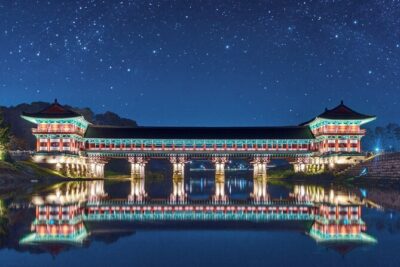
Gyeongju UNESCO World Heritage Guided Day Tour from Busan
Read our review →
Gyeongju UNESCO sites Private tour with licensed tour guide
Read our review →
Private Gyeongju Tour – Explore Gyeongju UNESCO Sites
Read our review →
Browse the lists this tour appears in